
- -$127.20


Our Privacy Policy explains our principles when it comes to the collection, processing, and storage of your information. This policy specifically explains how we employ cookies, as well as the options you have to control them.
Cookies are small pieces of data, stored in text files that are stored on your computer or other device when websites are loaded in a browser. They are widely used to "remember" you and your preferences, either for a single visit or for multiple repeat visits
We use cookies for a number of different purposes. Some cookies are necessary for technical reasons; some enable a personalized experience for both visitors and registered users; and some allow the display of advertising from selected third party networks.
Visitors may wish to restrict the use of cookies or completely prevent them from being set. If you disable cookies, please be aware that some of the features of our service may not function correctly
We only collect information about you if we have a reason to do so-for example, to provide our services, to communicate with you, or to make our services better.
We are committed to maintaining the trust and confidence of our website visitors. We do not collect, sell, rent or trade email lists or any data with other companies and businesses. Have a look at our Privacy Policy page to read detail information on when and why we collect your personal information, how we use it, the limited conditions under which we may disclose it to others and how we keep it secure.
We may change Cookies and Privacy policy from time to time. This policy is effective from 24th May 2018.

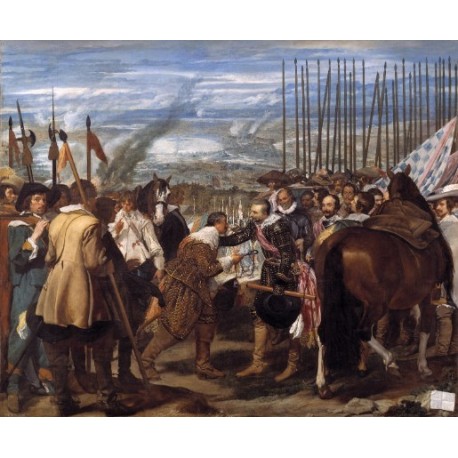
The Surrender of Breda, painted between 1634 and 1635 by the incomparable Diego Velázquez, stands as one of the most celebrated oil paintings in the history of Western art. Commissioned to adorn the Hall of Realms in the Buen Retiro Palace in Madrid, this monumental masterpiece captures the pivotal moment when the Dutch city of Breda fell to Spanish forces in 1625. What makes Velázquez's vision truly extraordinary is his remarkably humane portrayal of both victor and vanquished — the Spanish commander Ambrosio Spínola gently places his hand on the shoulder of the defeated Dutch governor Justin of Nassau, conveying a sense of dignified compassion rather than triumphant arrogance. The composition is a breathtaking symphony of lances, figures, and atmospheric landscape, demonstrating Velázquez's unrivaled ability to transform a political event into a timeless meditation on honor, mercy, and the human cost of war.
Now housed in the Museo del Prado in Madrid, this magnificent work continues to captivate art lovers and historians alike with its extraordinary technical brilliance and emotional depth. Velázquez employs a masterful use of light and shadow, drawing the viewer's eye effortlessly across the vast canvas, while his nuanced brushwork breathes life into every soldier, horse, and distant plume of smoke on the horizon. The painting's iconic forest of vertical lances — which earned it the Spanish nickname Las Lanzas — creates a dramatic visual rhythm that is both aesthetically stunning and symbolically rich. As a defining work within the Diego Velázquez collection, The Surrender of Breda remains an enduring testament to the artist's genius, offering collectors and enthusiasts a rare opportunity to connect with a piece of art history that has shaped the very language of European painting for nearly four centuries.