
- -$127.20


Our Privacy Policy explains our principles when it comes to the collection, processing, and storage of your information. This policy specifically explains how we employ cookies, as well as the options you have to control them.
Cookies are small pieces of data, stored in text files that are stored on your computer or other device when websites are loaded in a browser. They are widely used to "remember" you and your preferences, either for a single visit or for multiple repeat visits
We use cookies for a number of different purposes. Some cookies are necessary for technical reasons; some enable a personalized experience for both visitors and registered users; and some allow the display of advertising from selected third party networks.
Visitors may wish to restrict the use of cookies or completely prevent them from being set. If you disable cookies, please be aware that some of the features of our service may not function correctly
We only collect information about you if we have a reason to do so-for example, to provide our services, to communicate with you, or to make our services better.
We are committed to maintaining the trust and confidence of our website visitors. We do not collect, sell, rent or trade email lists or any data with other companies and businesses. Have a look at our Privacy Policy page to read detail information on when and why we collect your personal information, how we use it, the limited conditions under which we may disclose it to others and how we keep it secure.
We may change Cookies and Privacy policy from time to time. This policy is effective from 24th May 2018.
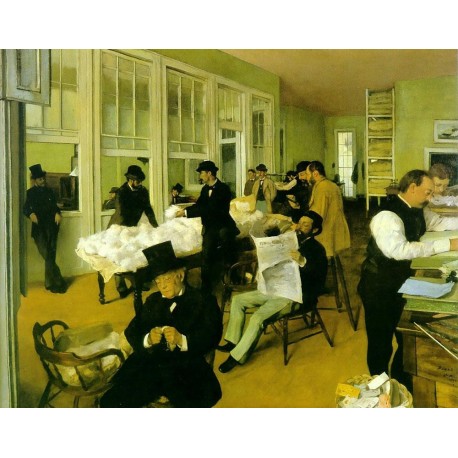
Edgar Degas's Portrait in a New Orleans Cotton Office stands as one of the most remarkable masterpieces in the history of Impressionism, capturing a vivid and intimate snapshot of 19th-century American commercial life. Painted in 1873 during Degas's visit to his maternal relatives in New Orleans, this extraordinary work depicts the bustling interior of a cotton brokerage office, populated by family members and business associates engaged in their daily routines. The composition is a triumph of naturalistic observation, with figures arranged across the canvas in a manner that feels both spontaneous and meticulously considered. The warm, diffused light filtering through the office windows bathes the scene in a golden luminosity that brings every detail — from the crisp white cotton samples to the absorbed expressions of the businessmen — to vivid, breathtaking life.
As one of Degas's most celebrated oil paintings, this work transcends its documentary function to become a profound meditation on modernity, labor, and the interconnectedness of family and commerce in post-Civil War America. The painting's masterful use of perspective draws the viewer's eye deep into the composition, creating an immersive sense of depth and spatial complexity that was revolutionary for its time. Currently housed in the Musée des Beaux-Arts de Pau in France, this iconic work continues to captivate art lovers and scholars worldwide, serving as an enduring testament to Degas's unparalleled genius in capturing the rhythms and textures of contemporary life with extraordinary sensitivity and skill.