
- -$127.20


Our Privacy Policy explains our principles when it comes to the collection, processing, and storage of your information. This policy specifically explains how we employ cookies, as well as the options you have to control them.
Cookies are small pieces of data, stored in text files that are stored on your computer or other device when websites are loaded in a browser. They are widely used to "remember" you and your preferences, either for a single visit or for multiple repeat visits
We use cookies for a number of different purposes. Some cookies are necessary for technical reasons; some enable a personalized experience for both visitors and registered users; and some allow the display of advertising from selected third party networks.
Visitors may wish to restrict the use of cookies or completely prevent them from being set. If you disable cookies, please be aware that some of the features of our service may not function correctly
We only collect information about you if we have a reason to do so-for example, to provide our services, to communicate with you, or to make our services better.
We are committed to maintaining the trust and confidence of our website visitors. We do not collect, sell, rent or trade email lists or any data with other companies and businesses. Have a look at our Privacy Policy page to read detail information on when and why we collect your personal information, how we use it, the limited conditions under which we may disclose it to others and how we keep it secure.
We may change Cookies and Privacy policy from time to time. This policy is effective from 24th May 2018.
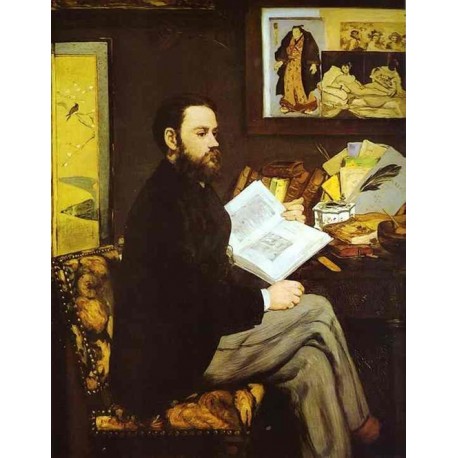
The Portrait of Emile Zola 1868 by Édouard Manet is one of the most celebrated and intellectually rich works in the history of Impressionist art. Painted as a gesture of gratitude toward the renowned French novelist and critic Émile Zola, who had passionately defended Manet's controversial artistic vision, this masterpiece captures far more than a simple likeness. Zola is depicted in his study, surrounded by books, papers, and meaningful visual references — including a small reproduction of Manet's own scandalous Olympia pinned to the wall behind him. The composition is a sophisticated dialogue between art and literature, friendship and intellectual solidarity, rendered with Manet's signature bold brushwork and masterful command of tone and color.
Among the finest oil paintings to emerge from nineteenth-century Paris, this portrait exemplifies Manet's revolutionary approach to realism and his ability to infuse everyday subjects with profound cultural meaning. The meticulous attention to detail — from the texture of Zola's dark jacket to the carefully arranged objects on his desk — reflects Manet's deep admiration for his subject while simultaneously asserting his own artistic identity. The subtle interplay of light and shadow, combined with the rich, layered palette, gives the work an enduring vitality that continues to captivate art lovers and scholars alike. Displayed today in the Musée d'Orsay in Paris, this iconic portrait stands as a timeless testament to the power of creative camaraderie and the enduring legacy of Édouard Manet's genius.