
- -$127.20


Our Privacy Policy explains our principles when it comes to the collection, processing, and storage of your information. This policy specifically explains how we employ cookies, as well as the options you have to control them.
Cookies are small pieces of data, stored in text files that are stored on your computer or other device when websites are loaded in a browser. They are widely used to "remember" you and your preferences, either for a single visit or for multiple repeat visits
We use cookies for a number of different purposes. Some cookies are necessary for technical reasons; some enable a personalized experience for both visitors and registered users; and some allow the display of advertising from selected third party networks.
Visitors may wish to restrict the use of cookies or completely prevent them from being set. If you disable cookies, please be aware that some of the features of our service may not function correctly
We only collect information about you if we have a reason to do so-for example, to provide our services, to communicate with you, or to make our services better.
We are committed to maintaining the trust and confidence of our website visitors. We do not collect, sell, rent or trade email lists or any data with other companies and businesses. Have a look at our Privacy Policy page to read detail information on when and why we collect your personal information, how we use it, the limited conditions under which we may disclose it to others and how we keep it secure.
We may change Cookies and Privacy policy from time to time. This policy is effective from 24th May 2018.
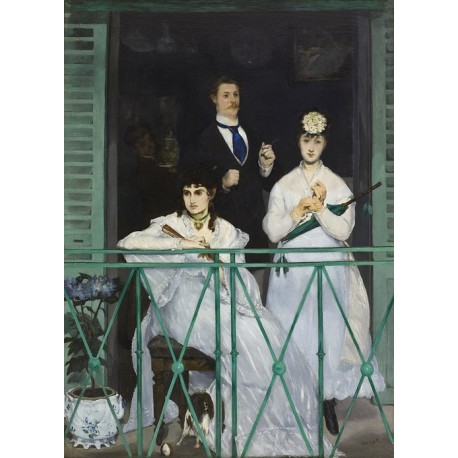
Edouard Manet's The Balcony (1868) stands as one of the most captivating and enigmatic masterpieces in the history of Western art. Depicting three elegantly dressed figures — the violinist Fanny Claus, the painter Berthe Morisot, and the landscape artist Antoine Guillemet — posed on a Parisian balcony, this remarkable work challenges conventional notions of portraiture and social interaction. The figures appear simultaneously present and psychologically distant, each lost in their own private world, creating a haunting sense of disconnection that feels strikingly modern even today. The bold contrast between the vivid green ironwork of the balcony railing and the luminous white garments of the subjects showcases Manet's extraordinary command of color and composition, drawing the viewer's eye into a scene that is at once intimate and deeply mysterious.
As one of Manet's finest oil paintings, The Balcony reflects the artist's revolutionary approach to depicting contemporary Parisian life, a hallmark of the Impressionist era he helped define. Inspired by Francisco Goya's Majas on a Balcony, Manet transformed his source material into something entirely his own — a work that defies easy narrative interpretation and invites endless contemplation. The painting was exhibited at the Paris Salon of 1869, where it provoked both admiration and bewilderment from critics and the public alike. Today, housed in the Musée d'Orsay in Paris, it remains a testament to Manet's genius and his enduring influence on the trajectory of modern art, making a reproduction of this iconic work a breathtaking addition to any collection.