
- -$127.20


Our Privacy Policy explains our principles when it comes to the collection, processing, and storage of your information. This policy specifically explains how we employ cookies, as well as the options you have to control them.
Cookies are small pieces of data, stored in text files that are stored on your computer or other device when websites are loaded in a browser. They are widely used to "remember" you and your preferences, either for a single visit or for multiple repeat visits
We use cookies for a number of different purposes. Some cookies are necessary for technical reasons; some enable a personalized experience for both visitors and registered users; and some allow the display of advertising from selected third party networks.
Visitors may wish to restrict the use of cookies or completely prevent them from being set. If you disable cookies, please be aware that some of the features of our service may not function correctly
We only collect information about you if we have a reason to do so-for example, to provide our services, to communicate with you, or to make our services better.
We are committed to maintaining the trust and confidence of our website visitors. We do not collect, sell, rent or trade email lists or any data with other companies and businesses. Have a look at our Privacy Policy page to read detail information on when and why we collect your personal information, how we use it, the limited conditions under which we may disclose it to others and how we keep it secure.
We may change Cookies and Privacy policy from time to time. This policy is effective from 24th May 2018.
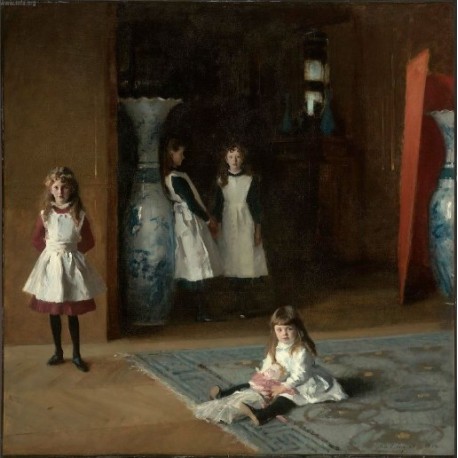
The Daughters of Edward Darley Boit is one of the most celebrated and psychologically compelling masterworks ever produced by John Singer Sargent, painted in 1882 and now housed in the Museum of Fine Arts in Boston. This extraordinary composition depicts the four young daughters of American expatriate Edward Darley Boit — Florence, Jane, Mary Louisa, and Julia — arranged in a shadowy Parisian interior with a striking sense of mystery and spatial depth. Unlike conventional Victorian-era portraiture, Sargent deliberately chose an asymmetrical arrangement, placing the youngest child in the foreground bathed in soft light while the older girls recede into the dimly lit background, creating an almost theatrical tension between presence and absence. The monumental Japanese vases that flank the composition further elevate the work's visual drama, underscoring Sargent's genius for integrating objects and figures into a unified, evocative narrative.
Among the finest oil paintings of the Gilded Age, this work demonstrates Sargent's unparalleled mastery of light, atmosphere, and psychological portraiture, drawing clear inspiration from the compositional boldness of Diego Velázquez's Las Meninas. The loose, confident brushwork and the subtle interplay of shadow and illumination reflect Sargent's deep roots in the Impressionist tradition while asserting his own singular artistic voice. Each daughter's gaze — or deliberate avoidance thereof — invites viewers to contemplate themes of childhood, innocence, and the passage of time. This painting remains an essential touchstone for collectors, art historians, and enthusiasts who seek to understand the full depth and brilliance of John Singer Sargent's enduring legacy in Western art history.