
- -$127.20


Our Privacy Policy explains our principles when it comes to the collection, processing, and storage of your information. This policy specifically explains how we employ cookies, as well as the options you have to control them.
Cookies are small pieces of data, stored in text files that are stored on your computer or other device when websites are loaded in a browser. They are widely used to "remember" you and your preferences, either for a single visit or for multiple repeat visits
We use cookies for a number of different purposes. Some cookies are necessary for technical reasons; some enable a personalized experience for both visitors and registered users; and some allow the display of advertising from selected third party networks.
Visitors may wish to restrict the use of cookies or completely prevent them from being set. If you disable cookies, please be aware that some of the features of our service may not function correctly
We only collect information about you if we have a reason to do so-for example, to provide our services, to communicate with you, or to make our services better.
We are committed to maintaining the trust and confidence of our website visitors. We do not collect, sell, rent or trade email lists or any data with other companies and businesses. Have a look at our Privacy Policy page to read detail information on when and why we collect your personal information, how we use it, the limited conditions under which we may disclose it to others and how we keep it secure.
We may change Cookies and Privacy policy from time to time. This policy is effective from 24th May 2018.
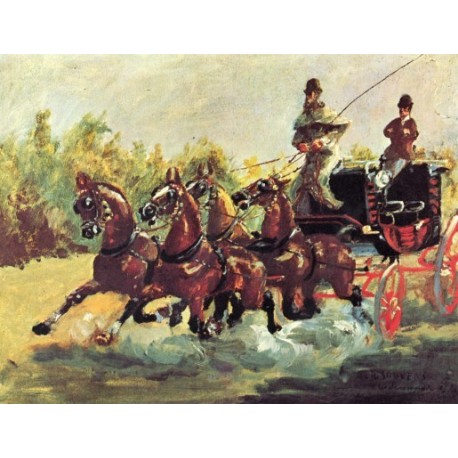
Henri de Toulouse-Lautrec's Alphonse de Toulouse-Lautrec Driving His Four in Hand, painted in 1880, is a remarkable early masterpiece that offers an intimate glimpse into the artist's world before he became the celebrated chronicler of Montmartre's vibrant nightlife. Created when Lautrec was just a teenager, this stunning work depicts his father, Count Alphonse de Toulouse-Lautrec, skillfully commanding a horse-drawn carriage with effortless aristocratic authority. The composition radiates dynamic energy, capturing the spirited movement of the horses with a confidence and technical brilliance that belies the artist's young age. The warm, earthy tones and fluid brushwork already hint at the extraordinary talent that would define one of the most distinctive voices in Post-Impressionist art.
Among the finest oil paintings from Lautrec's formative years, this work holds a deeply personal significance, as it immortalizes the complex relationship between the young artist and his eccentric, larger-than-life father. The scene is rendered with both affection and keen observational precision, showcasing Lautrec's innate ability to capture character and movement in a single, frozen moment. The painting stands as a testament to his early passion for equestrian subjects, a theme that would recur throughout his career before his focus shifted to the theaters, cabarets, and dance halls of Paris. Today, this extraordinary piece remains a treasured window into the private world of a noble family and the blossoming genius of one of art history's most beloved and unconventional masters.