
- -$127.20


Our Privacy Policy explains our principles when it comes to the collection, processing, and storage of your information. This policy specifically explains how we employ cookies, as well as the options you have to control them.
Cookies are small pieces of data, stored in text files that are stored on your computer or other device when websites are loaded in a browser. They are widely used to "remember" you and your preferences, either for a single visit or for multiple repeat visits
We use cookies for a number of different purposes. Some cookies are necessary for technical reasons; some enable a personalized experience for both visitors and registered users; and some allow the display of advertising from selected third party networks.
Visitors may wish to restrict the use of cookies or completely prevent them from being set. If you disable cookies, please be aware that some of the features of our service may not function correctly
We only collect information about you if we have a reason to do so-for example, to provide our services, to communicate with you, or to make our services better.
We are committed to maintaining the trust and confidence of our website visitors. We do not collect, sell, rent or trade email lists or any data with other companies and businesses. Have a look at our Privacy Policy page to read detail information on when and why we collect your personal information, how we use it, the limited conditions under which we may disclose it to others and how we keep it secure.
We may change Cookies and Privacy policy from time to time. This policy is effective from 24th May 2018.
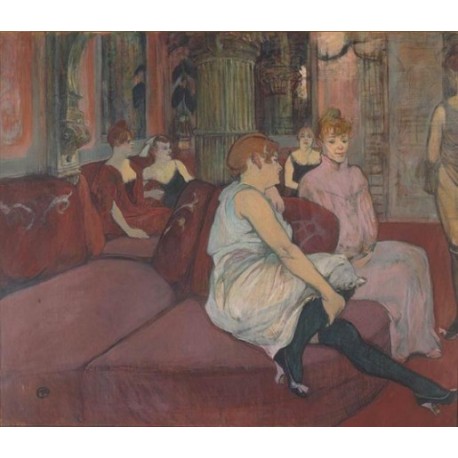
Henri de Toulouse-Lautrec's Salon de la Rue des Moulins (1894) stands as one of the most compelling and unflinching masterpieces in the history of Post-Impressionist art. Painted with Lautrec's signature bold lines and vivid, expressive palette, this extraordinary work offers an intimate and humanizing glimpse into the daily life of the women working at one of Paris's most famous brothels. Far from sensationalizing his subjects, Lautrec portrays them with remarkable empathy and psychological depth — seated, waiting, resting — capturing a quiet, unguarded moment that transcends its controversial setting. The composition's sweeping perspective, rich warm tones, and masterful use of pastel and oil paintings techniques combine to create a scene of haunting beauty and raw authenticity that continues to captivate art lovers and historians alike.
As a defining work within the Lautrec collection, Salon de la Rue des Moulins exemplifies the artist's extraordinary ability to document Parisian society with both critical honesty and genuine compassion. Lautrec, who was a regular visitor to the establishment, developed personal relationships with its inhabitants, and this intimacy is palpable in every brushstroke. The painting's theatrical use of color, the languid postures of the figures, and the opulent yet melancholic interior all reflect Lautrec's genius for storytelling through visual art. Whether displayed in a world-class museum or reproduced as a fine art print, this iconic work remains an essential piece of cultural heritage — a timeless window into the hidden corners of Belle Époque Paris that only Toulouse-Lautrec had the courage and sensitivity to illuminate.