
- -$127.20


Our Privacy Policy explains our principles when it comes to the collection, processing, and storage of your information. This policy specifically explains how we employ cookies, as well as the options you have to control them.
Cookies are small pieces of data, stored in text files that are stored on your computer or other device when websites are loaded in a browser. They are widely used to "remember" you and your preferences, either for a single visit or for multiple repeat visits
We use cookies for a number of different purposes. Some cookies are necessary for technical reasons; some enable a personalized experience for both visitors and registered users; and some allow the display of advertising from selected third party networks.
Visitors may wish to restrict the use of cookies or completely prevent them from being set. If you disable cookies, please be aware that some of the features of our service may not function correctly
We only collect information about you if we have a reason to do so-for example, to provide our services, to communicate with you, or to make our services better.
We are committed to maintaining the trust and confidence of our website visitors. We do not collect, sell, rent or trade email lists or any data with other companies and businesses. Have a look at our Privacy Policy page to read detail information on when and why we collect your personal information, how we use it, the limited conditions under which we may disclose it to others and how we keep it secure.
We may change Cookies and Privacy policy from time to time. This policy is effective from 24th May 2018.
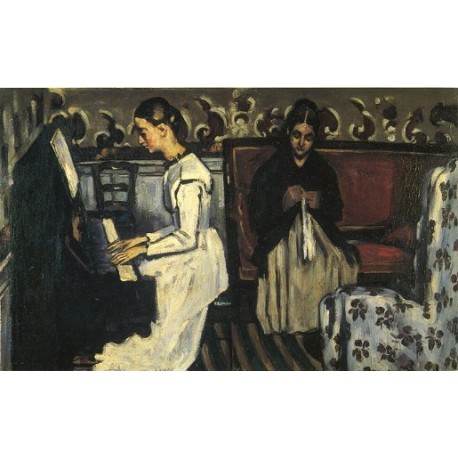
Paul Cézanne's Young Girl at the Piano – Overture to Tannhäuser, painted in 1868, is one of the most intimate and emotionally resonant works in the artist's early career. This remarkable piece depicts a young woman seated at a piano, her fingers delicately poised over the keys, while a second female figure sits nearby engaged in needlework. The composition is bathed in soft, muted tones of grey, white, and warm ochre, creating an atmosphere of quiet domesticity and refined elegance. The painting's title references Richard Wagner's celebrated opera overture, suggesting that the scene captures a moment of musical performance deeply tied to the cultural and intellectual life of 19th-century France. As one of Cézanne's most accomplished oil paintings, this work reveals his extraordinary sensitivity to light, texture, and human emotion during a period when he was still developing the revolutionary visual language that would later define Post-Impressionism.
Currently housed in the Hermitage Museum in Saint Petersburg, Young Girl at the Piano stands as a testament to Cézanne's evolving mastery and his deep admiration for the Old Masters. The careful arrangement of figures within the domestic interior, combined with the subtle interplay of light and shadow across the wallpapered background and the piano's polished surface, demonstrates a compositional sophistication that anticipates his later groundbreaking works. The painting invites viewers into a world of cultured leisure and feminine grace, offering a window into bourgeois Parisian life during the Second Empire. Collectors and art enthusiasts who appreciate Cézanne's genius will find this work to be an enduring source of beauty, historical significance, and artistic inspiration, making it one of the most treasured pieces within the Paul Cézanne collection.