
- -$127.20


Our Privacy Policy explains our principles when it comes to the collection, processing, and storage of your information. This policy specifically explains how we employ cookies, as well as the options you have to control them.
Cookies are small pieces of data, stored in text files that are stored on your computer or other device when websites are loaded in a browser. They are widely used to "remember" you and your preferences, either for a single visit or for multiple repeat visits
We use cookies for a number of different purposes. Some cookies are necessary for technical reasons; some enable a personalized experience for both visitors and registered users; and some allow the display of advertising from selected third party networks.
Visitors may wish to restrict the use of cookies or completely prevent them from being set. If you disable cookies, please be aware that some of the features of our service may not function correctly
We only collect information about you if we have a reason to do so-for example, to provide our services, to communicate with you, or to make our services better.
We are committed to maintaining the trust and confidence of our website visitors. We do not collect, sell, rent or trade email lists or any data with other companies and businesses. Have a look at our Privacy Policy page to read detail information on when and why we collect your personal information, how we use it, the limited conditions under which we may disclose it to others and how we keep it secure.
We may change Cookies and Privacy policy from time to time. This policy is effective from 24th May 2018.
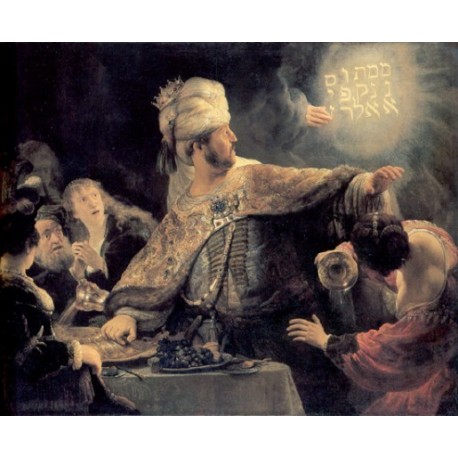
Rembrandt's The Feast of Belshazzar – The Writing on the Wall, painted in 1635, stands as one of the most dramatically powerful and visually arresting oil paintings in the history of Western art. Housed in the National Gallery in London, this monumental masterpiece captures the precise, spine-chilling moment described in the Book of Daniel, when a mysterious divine hand inscribes a cryptic message upon the wall during the opulent feast of the Babylonian king Belshazzar. Rembrandt's extraordinary command of light and shadow — his signature chiaroscuro technique — floods the scene with an almost supernatural luminescence, illuminating the terror-stricken faces of the king and his guests as golden vessels and rich fabrics catch the blazing light. The composition is alive with movement and emotion, from the wine spilling from an overturned goblet to the wide-eyed disbelief etched across every figure's face, making this a breathtaking study in human vulnerability before divine power.
What makes this work particularly remarkable is Rembrandt's meticulous attention to historical and cultural authenticity, as evidenced by the Hebrew inscription rendered in a unique vertical script, a detail the artist researched with the help of his contemporary, the Amsterdam rabbi and scholar Menasseh ben Israel. The richly layered textures of Belshazzar's jeweled robes, the gleaming metallic surfaces of the sacred vessels, and the deep, velvety darkness of the background all demonstrate Rembrandt's unparalleled technical virtuosity at the height of his creative powers. This painting is not merely a religious narrative — it is a profound meditation on hubris, divine judgment, and the fragility of earthly power, rendered with an emotional depth and theatrical intensity that continues to captivate scholars, collectors, and art lovers more than three centuries after its creation. A true cornerstone of the Rembrandt collection, this work is an essential testament to the Dutch Golden Age's enduring artistic legacy.