
- -$127.20


Our Privacy Policy explains our principles when it comes to the collection, processing, and storage of your information. This policy specifically explains how we employ cookies, as well as the options you have to control them.
Cookies are small pieces of data, stored in text files that are stored on your computer or other device when websites are loaded in a browser. They are widely used to "remember" you and your preferences, either for a single visit or for multiple repeat visits
We use cookies for a number of different purposes. Some cookies are necessary for technical reasons; some enable a personalized experience for both visitors and registered users; and some allow the display of advertising from selected third party networks.
Visitors may wish to restrict the use of cookies or completely prevent them from being set. If you disable cookies, please be aware that some of the features of our service may not function correctly
We only collect information about you if we have a reason to do so-for example, to provide our services, to communicate with you, or to make our services better.
We are committed to maintaining the trust and confidence of our website visitors. We do not collect, sell, rent or trade email lists or any data with other companies and businesses. Have a look at our Privacy Policy page to read detail information on when and why we collect your personal information, how we use it, the limited conditions under which we may disclose it to others and how we keep it secure.
We may change Cookies and Privacy policy from time to time. This policy is effective from 24th May 2018.

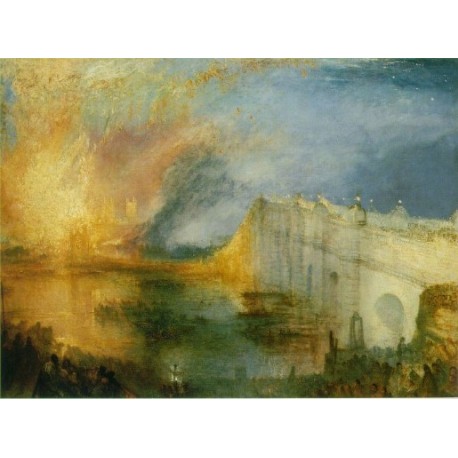
Joseph Mallord William Turner's The Burning of the Houses of Lords and Commons stands as one of the most electrifying and emotionally charged works in the history of British art. Painted in 1835, this masterpiece captures the catastrophic fire of October 16, 1834, which consumed the iconic Palace of Westminster in a blaze that transfixed thousands of spectators along the Thames. Turner, who witnessed the event firsthand, transformed a moment of national catastrophe into a sublime vision of light, color, and raw elemental power. The painting radiates with molten golds, fierce oranges, and incandescent reds that seem to pulse with living energy, reflecting off the dark waters of the river in a breathtaking display of luminosity. As one of Turner's most celebrated oil paintings on canvas, it exemplifies his revolutionary approach to depicting light and atmosphere, dissolving solid forms into swirling, almost abstract passages of color that would go on to influence generations of artists, including the French Impressionists.
What makes this work truly extraordinary is Turner's ability to capture not merely the physical spectacle of the fire, but its profound psychological and emotional resonance. The tiny silhouettes of awestruck crowds lining the riverbank serve as a humbling counterpoint to the overwhelming scale of the inferno, reminding the viewer of humanity's fragility in the face of nature's and history's unstoppable forces. The composition masterfully balances chaos and order, with the arching bridge of Westminster providing a structural anchor amidst the swirling vortex of flame and smoke. Housed today in the Philadelphia Museum of Art and the Cleveland Museum of Art in two celebrated versions, this painting continues to captivate audiences worldwide, serving as a timeless testament to Turner's unparalleled genius and his visionary ability to find transcendent beauty even in the heart of destruction.